
Why STRC Trades Near $100 While Bitcoin Draws Down
Executive Summary
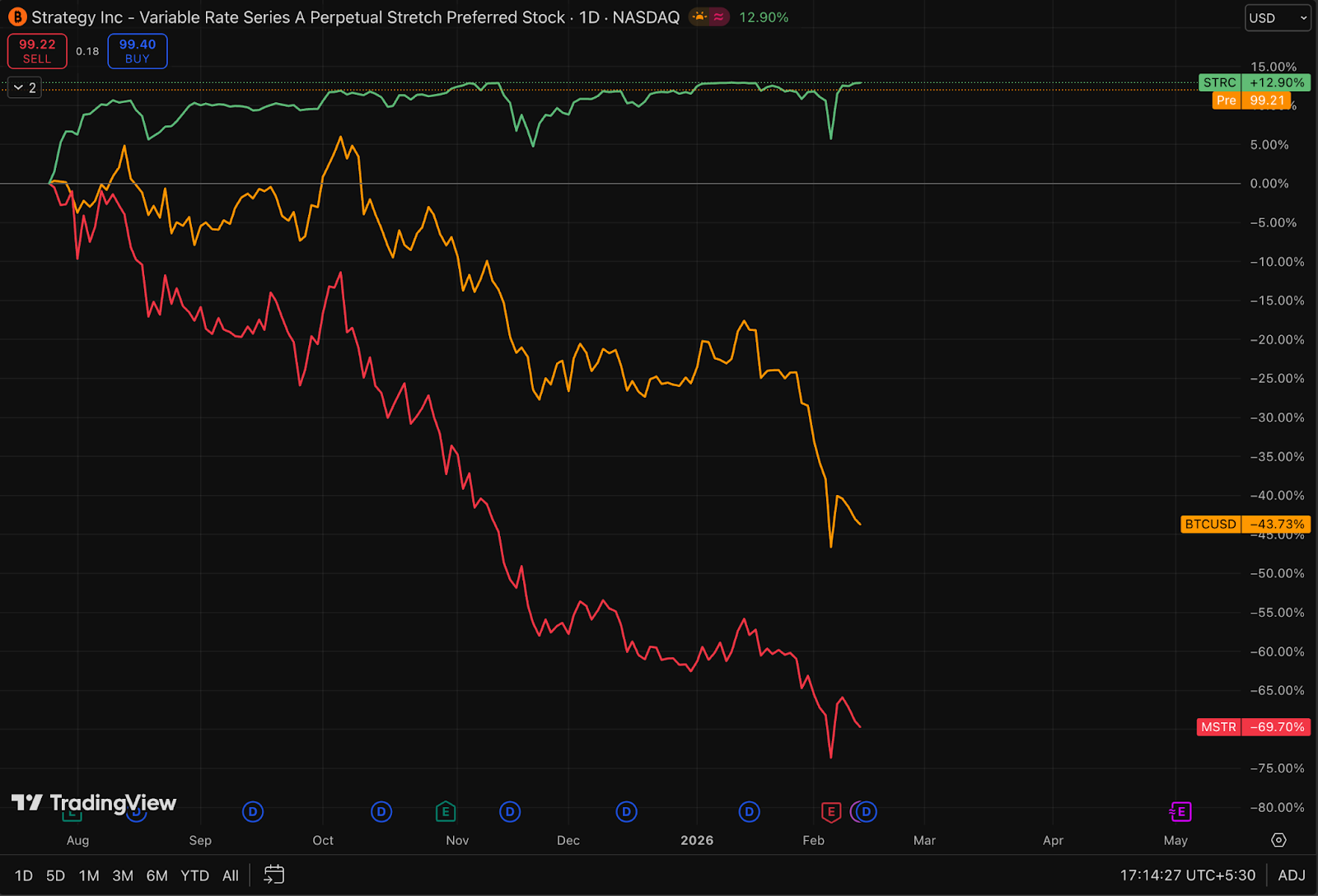
Early 2026 delivered a violent stress test for every instrument indirectly linked to Bitcoin. Spot BTC fell roughly 50% from late-2025 highs, compressing equity risk premia and detonating P&L optics for bitcoin-exposed corporates. Yet Strategy Inc.’s Variable Rate Series A Perpetual Stretch Preferred (STRC) largely maintained a ~$100 trading anchor with comparatively muted realized volatility.
This apparent “decoupling” is not magic, nor a contradiction of correlation metrics. It is the consequence of deliberate capital-structure engineering built on three pillars:
- Structural seniority and a thick equity buffer beneath STRC (common equity as the primary shock absorber).
- A variable-rate dividend mechanism explicitly designed to defend a price target (raise yield to offset widening required returns rather than letting price gap down).
- A dedicated fiat liquidity engine (“USD Reserve”) funded via ATM issuance that enables the company to pay the elevated coupon without selling BTC at least across a multi-year runway.
STRC’s resilience is therefore best understood as a senior claim on a corporate liquidity-and-issuance machine, not as a direct proxy for Bitcoin beta.
Macro Regime: Why 2026 Was a Real Stress Test
The early-2026 regime combined (i) tight/uncertain monetary conditions, (ii) crowded positioning in digital assets, and (iii) reflexive deleveraging across liquid and pseudo-liquid venues. The result: correlation spikes inside crypto, ETF outflows, and liquidation cascades that punished any balance sheet perceived to be “BTC-duration.”
In that environment, the obvious expectation is that all “Bitcoin-adjacent” risk assets especially those issued by the largest Bitcoin Treasury Company should reprice sharply. MSTR common did. STRC largely didn’t.
That divergence is the entire point of STRC’s design.
Strategy Inc.: From Software Company to Bitcoin Treasury Platform
Strategy’s transformation has turned its capital structure into a distribution mechanism for BTC-linked risk:
- Common equity absorbs volatility and monetizes investor demand for leveraged BTC exposure.
- Preferred tranches harvest that monetization as yield instruments with varying duration, optionality, and seniority.
- Debt and other liabilities sit above equity but are serviced alongside preferred obligations through planned liquidity buffers.
In practice, the firm has evolved into a synthetic issuer of Bitcoin-linked credit not by collateralizing BTC directly, but by using market access and internal treasury policy to create bond-like payoffs for specific investor mandates.
Where STRC Sits: The Capital Stack as Shock Absorber
STRC’s first defense is positioning. It sits above junior preferreds and common equity, and below only the most senior claims (including senior debt and any senior preferred with priority).
A simplified hierarchy:
- Senior debt / senior claims
- Senior preferred (e.g., STRF)
- STRC (variable-rate, par-targeted)
- Other preferred tranches (more subordinated / optionality features)
- Common equity (MSTR): the volatility sponge
When BTC collapses, the market value impact is transmitted first into common equity (and secondarily into more junior instruments). STRC benefits from a buffer measured in the residual enterprise value that must be impaired before STRC’s claim becomes the focal point of solvency pricing.
This is not “Bitcoin immunity.” It is capital structure insulation.
The Critical Legal Reality: No Direct BTC Collateral
Despite the “Bitcoin treasury” narrative, STRC is not a tokenized claim on BTC. It is an unsecured preferred equity claim on Strategy Inc.
That nuance matters for both risk analysis and pricing:
- STRC holders do not possess an enforceable lien on BTC.
- Protection is delivered via seniority, liquidation preference terms, and corporate liquidity policy, not via custody structure.
In a liquidation, outcomes depend on total asset value vs. senior obligations not on any direct BTC ring-fencing.
The Core Innovation: A Dividend That Defends Price, Not Vice Versa
Perpetual preferreds typically obey simple math: if perceived risk rises, required yield rises, and price falls (for fixed-rate securities). STRC inverts this.
STRC’s Mechanism
STRC features a monthly adjustable dividend rate with governance designed to keep the security trading “at or near” $100. When STRC trades below target, the issuer can raise the dividend rate; when it trades above, the issuer can reduce it subject to guardrails that constrain downward moves.
In effect, STRC behaves like a managed-rate perpetual where the issuer actively supplies yield until market clearing occurs at the target price.
Why This Works (Until It Doesn’t)
This structure is attractive to:
- Short-duration / income mandates that want high carry with limited price volatility
- Relative-value buyers who arbitrage discounts to par when dividend adjustments are expected
- Portfolio managers who mark positions to market but prefer minimal drawdowns
A “dip” below par becomes self-correcting if and only if the issuer can credibly fund the higher dividend.
That “if” is the fulcrum of the entire system.
The Funding Question: The USD Reserve as the Real Collateral
A par peg is only as credible as the issuer’s liquidity. STRC’s stability is therefore primarily a story of cash management, not merely structural seniority.
The Fiat Engine
Strategy established and expanded a USD Reserve earmarked for:
- preferred dividends
- interest on debt
- related corporate obligations
Crucially, this reserve is not primarily funded by software free cash flow. It is funded by ATM issuance especially common equity issuance when MSTR trades at a premium to underlying BTC NAV.
This is the architecture:
- Market assigns MSTR a premium (mNAV > 1) for leveraged BTC exposure.
- Strategy sells equity via ATM → harvests fiat.
- Fiat funds preferred coupons (including STRC) → stabilizes senior instruments.
- Common absorbs dilution and volatility; preferreds receive stability and carry.
In short: common shareholders subsidize preferred stability through dilution during periods of market access.
Why STRC Can Be Correlated Yet Not Volatile
Market participants often confuse correlation with drawdown magnitude.
- Correlation describes directional co-movement frequency.
- Volatility / beta describes magnitude.
STRC can trade “sympathetically” with BTC intraday (risk-on/risk-off flows) while remaining anchored by a credible par-defense mechanism. Small selloffs are met by incremental yield increases and arbitrage demand; rallies are capped because the instrument is not designed to trade at persistent premiums.
This is volatility suppression through issuer policy, not an absence of linkage.
Tax Characterization: ROC as a Demand Multiplier
A second-order (but powerful) stabilizer is after-tax yield attractiveness.
When distributions are characterized as Return of Capital (ROC) rather than ordinary dividends, the effective after-tax carry can be meaningfully higher for certain holders, creating stickier ownership and reinforcing the “buy-the-dip-to-par” behavior.
Even without leaning on tax advantages, the core point remains: STRC’s design appeals to mandates that value carry + price stability more than convex upside.
The Hidden Risk: Reflexivity and the “Death Spiral” Setup
STRC’s resilience in a 50% BTC drawdown does not eliminate risk; it transforms it.
The key systemic vulnerability is reflexive:
- STRC stability requires dividend flexibility.
- Dividend flexibility requires cash.
- Cash is substantially sourced from ATM issuance.
- ATM issuance is viable when MSTR maintains a premium and equity markets remain receptive.
Collapse Pathway (Conceptual)
A prolonged regime where BTC remains below (or meaningfully under) Strategy’s average cost basis can compress the MSTR premium. If mNAV approaches or falls below 1, issuing equity becomes more punitive:
- ATM economics worsen (dilution increases for each dollar raised).
- USD Reserve depletes as coupons and interest remain fixed in fiat terms.
- STRC discount widens if the market questions funding durability.
- The framework pushes toward higher coupons to defend par.
- Higher coupons accelerate reserve burn → feedback loop.
That is the classic “defend the peg” reflexivity: defending price through higher carry is stabilizing in normal stress, but destabilizing when the funding source is impaired.
Contagion Channels
The risk expands if STRC is rehypothecated as “stable collateral” inside structured products or tokenized wrappers. A par break can force forced selling in instruments that assumed STRC was “cash-like,” amplifying downside.
What STRC Really Is
STRC is best modeled as:
- a managed-rate perpetual preferred
- with a target-price objective
- funded by issuer liquidity policy and capital markets access
- sitting atop a thick equity buffer (common absorbs shocks)
It is not a BTC-backed bond in the strict sense. It is a senior claim on a corporate platform whose business model is: convert equity volatility and premium into fiat yield instruments.
Conclusion: A Masterclass With a Clear Breaking Point
STRC’s performance through early-2026 volatility is not a market anomaly; it is the intended outcome of Strategy’s digital credit architecture. The instrument maintained stability because Strategy chose to pay up in yield rather than allow a price reset, and because it built (and funded) a fiat runway that made that promise credible.
But STRC’s brilliance is inseparable from its singular fragility: it depends on Strategy’s ongoing ability to monetize equity demand to finance fixed fiat obligations. If the equity premium collapses for long enough, the par-defense mechanism can invert from stabilizer to accelerant.
FOLLOW US ON:
X (Twitter), Youtube, Instagram, Linkedin
Access to these products and services is restricted to non-U.S. persons and may not be available in certain jurisdictions.